
Keeping Your Water Running: Insulating Well Houses and Pump Houses in Northern Colorado
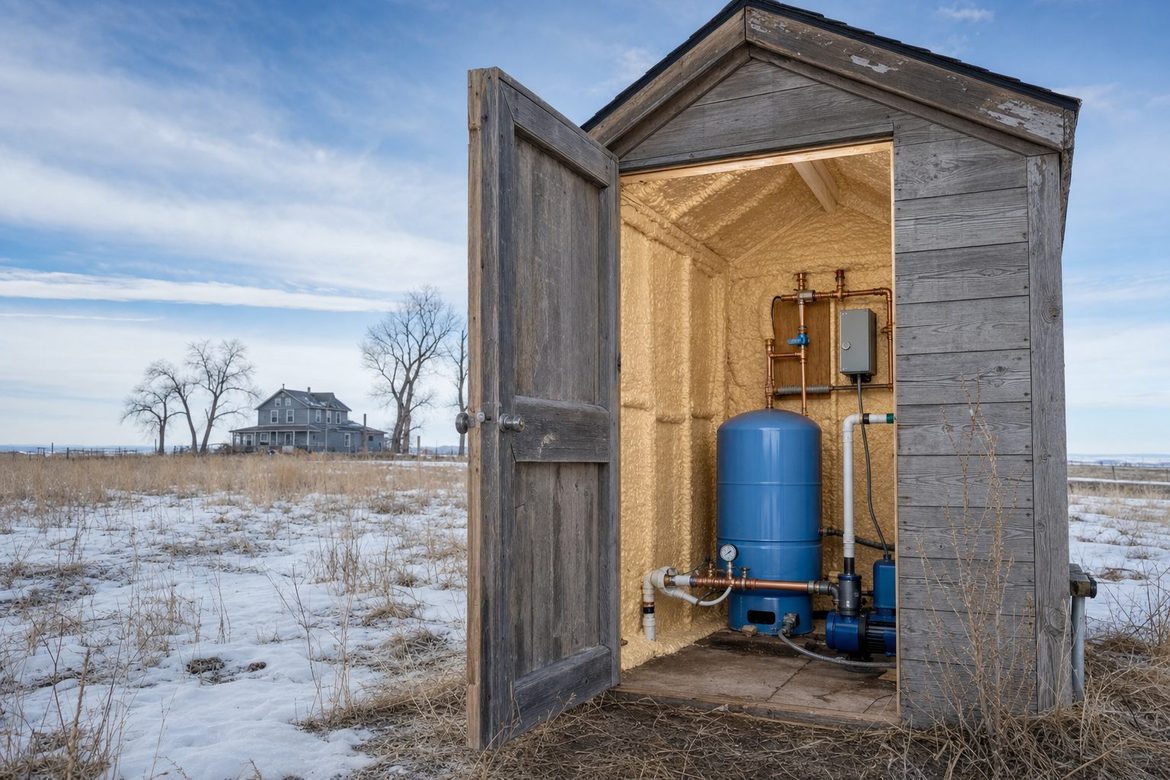
If you live out past the edge of town, your whole water supply may depend on a shed about the size of a closet. The pump, the pressure tank, the switch, and a few feet of pipe sit in there all winter, usually behind thin plywood walls and a door that never quite closes tight.
Most of the year, nobody thinks about it. Then comes the first below-zero night with a north wind across the plains, and the kitchen faucet coughs and goes quiet.
If that has happened to you once, you probably don't want it to happen again. Here is what actually goes wrong in a well house, what insulation can and can't do about it, and how to set yours up before the cold arrives.
Your Water Supply Lives in a Shed
Rural properties around Nunn, Wellington, Ault, Pierce, Laporte, and the rest of Weld and Larimer counties often have a pump house or well house separate from the home. Some are small wood-framed sheds. Some are old block buildings. Some are a box built over the wellhead decades ago by someone who is no longer around to ask.
What they tend to have in common is that nobody built them to hold heat. They were built to keep the snow off the equipment. That was fine until the equipment started depending on staying above freezing.
What Happens When a Pump House Freezes
Well pumps and the pipes around them start to be at risk once temperatures fall below about 20 °F, and wind speeds up the heat loss, so a drafty shed can run colder than the air outside it suggests. On the northern Colorado plains, that combination shows up every winter.
When it goes wrong, it usually goes wrong in this order:
- Water in the exposed pipe, pressure switch line, or tank fittings freezes first.
- You lose water pressure, or lose water entirely.
- As the ice expands, fittings, valves, or the pipe itself can crack.
- When it thaws, the crack leaks, often into a space nobody checks every day.
- If the pump keeps trying to run against a frozen line, the pump itself can be damaged.
The first two are an inconvenience. The last three are a repair bill, sometimes a big one, and they tend to happen on the coldest weekend of the year when everyone else in the county is calling the same well service.
Heat Tape Only Works When the Power Does
The usual fix is a heat lamp, a small space heater, or heat tape wrapped around the pipe. Those can work. The problem is that every one of them depends on electricity, and a power outage leaves the whole system unprotected at exactly the moment it is most likely to freeze (Well Doctor). Winter storms and wind are when rural lines go down.
Heat lamps have a second problem. Many are cheaply made, with thin cords and unreliable hanging points, and they have started more than a few farm building fires (Cornell Small Farms). A hot bulb in a small wooden shed is not something you want running unattended all winter.
This is where insulation earns its keep. Insulation doesn't make heat. What it does is hold onto the heat that is already there, from the ground, the well water, and whatever small heat source you use. A well-sealed, well-insulated pump house loses that heat slowly, so a small heater has to work less, and an outage buys you hours instead of minutes.
Why Closed-Cell Spray Foam Fits This Job
There are a few ways to insulate a pump house. Foam board and fiberglass batts are the common ones. For this particular building, closed-cell spray foam has some real advantages:
- It seals the drafts. Most pump houses leak air at every seam, corner, and pipe penetration. Spray foam fills those gaps as it goes on, which batts and boards don't do on their own.
- It handles moisture. A pump house is a damp place. Closed-cell foam doesn't soak up water the way fiberglass does.
- It sticks to odd surfaces. Block, rough lumber, old metal, and uneven framing are all fine.
- It insulates a lot per inch. Small buildings don't have deep walls to fill, so a high R-value in a thin layer matters.
- It stays put. Batts sag and fall out of walls in damp buildings. Foam bonds to the surface.
That said, it isn't a perfect product for every shed. It costs more than a few sheets of foam board, and a very small or temporary structure might not justify it. We would rather tell you that up front.
Moisture Is the Quiet Problem
Cold gets the attention, but moisture does the slow damage. Over time, damp air in a pump house corrodes pipes and fittings and can damage the wiring for the pump and pressure switch. Humid air near a cold surface also condenses, and condensation freezes faster than you'd expect.
Sealing the building helps keep damp outside air out. It does not fix a leaking fitting, a pressure relief valve that drains onto the floor, or water pooling around the base of the shed. Take care of those first. A pump house also still needs some way to vent in the warmer months so the pump doesn't overheat and humidity doesn't build up.
What a Good Pump House Job Looks Like
If you are having one done, or doing the planning yourself, a few details matter:
- Walls, ceiling, and the door. Heat leaves through the top and through the gaps around the door, so both need attention, not just the walls.
- Access stays clear. The pump, pressure tank, switch, electrical boxes, and valves all need to be reachable for service. Foam goes around them, not over them.
- The floor and base. Gaps where the walls meet the slab or ground are a big source of cold air, and a common entry point for mice.
- A safe heat source, if you keep one. Anything that makes heat should be rated for the space and kept away from the foam and wood.
- A covering, if code calls for it. Spray foam is a combustible material, and in many buildings code requires it to be covered. Requirements for outbuildings depend on the building and local interpretation (Green Building Advisor). A good contractor will tell you what applies to yours.
One honest note on mice: closed-cell foam is harder than foam board, but no insulation is truly rodent-proof. Sealing the gaps at the base is what keeps them out.
Well Houses, Stock Tank Lines, and Other Rural Weak Spots
The same thinking applies to other places on a rural property where water sits near cold air: hydrant and valve boxes, stock tank supply lines that run through a shed or barn wall, a pressure tank in a detached shop, or a small livestock waterer room. Anywhere a pipe runs through an unheated building is a candidate for a winter surprise.
If you already have spray foam work planned for a shop or ag building, it is usually worth doing the pump house on the same trip.
When Should You Do It?
Before it freezes. That sounds obvious, but pump houses tend to get fixed in January, after the first failure, when it is also harder to spray. Foam needs the surface it is going onto to be warm enough and dry enough to cure well, which is easier in fall than in the middle of a cold snap. An October or early November appointment is the sweet spot.
Thinking About Protecting Your Well House in Northern Colorado?
Distinctive Spray Foam is based in Nunn and works with rural homeowners, farms, and ranches across Weld and Larimer counties. We know what a pump house on the plains goes through in January, and we would rather help you get ahead of it than hear about it after the pipes split.
If your water supply lives in a shed and you'd like to stop worrying about it every cold night, request a free quote and we'll take a look before the first hard freeze.