
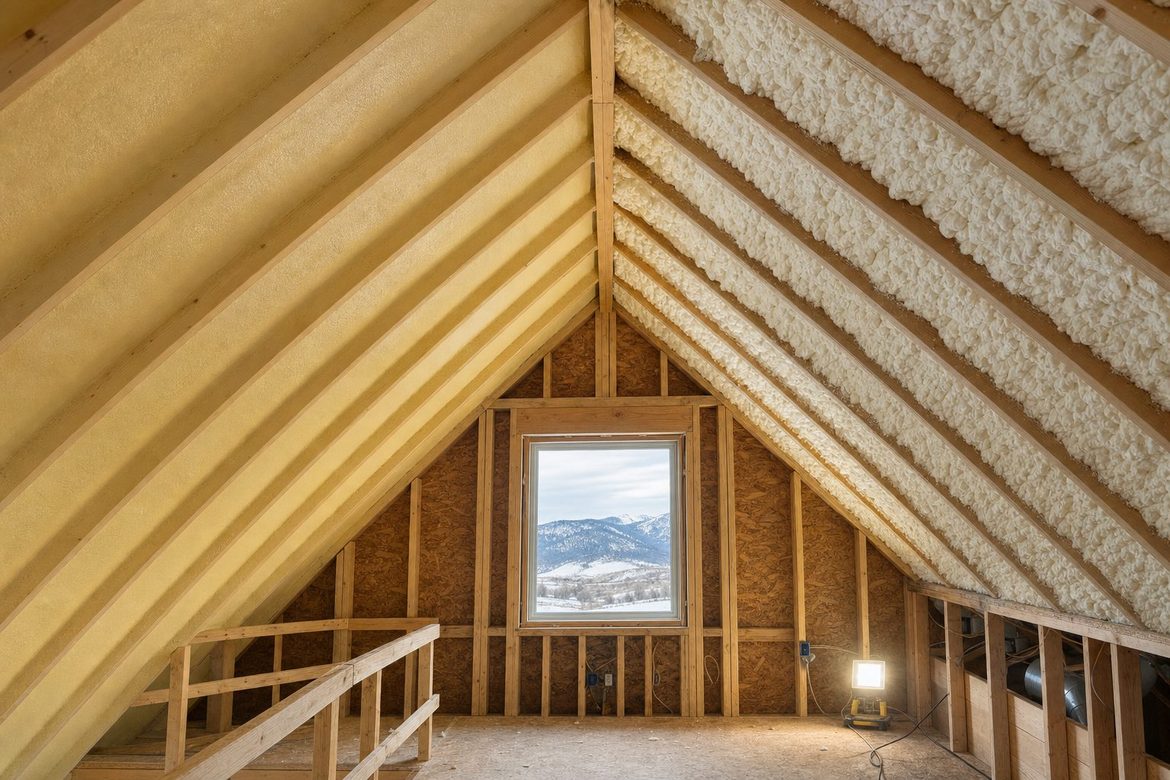
Open-Cell or Closed-Cell Spray Foam? The Colorado Answer Is Different
Ask three insulation companies which spray foam you should use and you will probably get three copies of the same chart. Open-cell on one side, closed-cell on the other. R-value per inch, cost per board foot, soft versus rigid. It looks like a menu, and it kind of is.
The trouble is that the chart works the same in Phoenix as it does in Fort Collins, and your house does not. Where you live changes which foam belongs where. In Northern Colorado, that difference is not a small footnote. In some spots, it is the whole decision.
So before you compare prices, it helps to understand what each foam actually does, and why a cold, dry, windy climate like ours tips the scale.
The Comparison Chart Everyone Shows You
Here is the short version, since you will see it everywhere anyway.
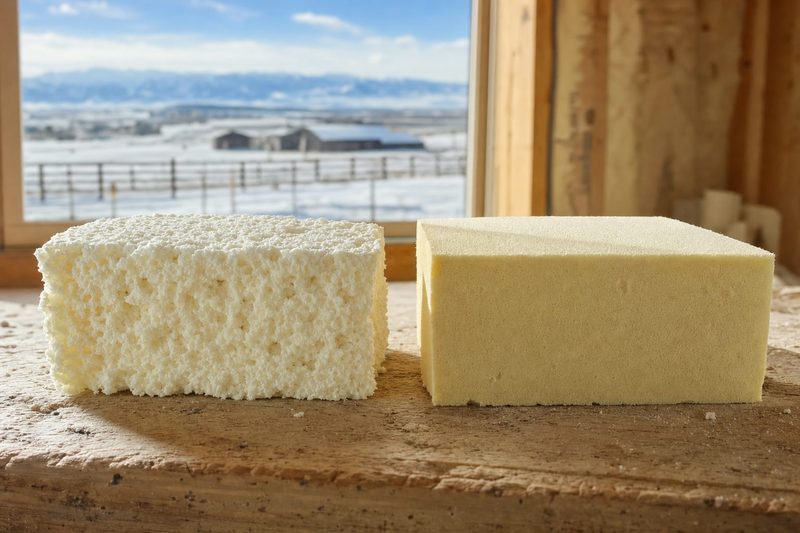
Open-cell spray foam is the light, spongy one. The tiny cells inside it are not fully closed, so it stays soft, expands a lot, and comes in around R-3.5 to R-3.7 per inch. It is the more affordable option, and it is very good at quieting a room.
Closed-cell spray foam is the dense, rigid one. Its cells are sealed and filled with a gas that insulates better than air, which is how it reaches roughly R-6 to R-7 per inch. It resists water, adds stiffness to whatever it is sprayed on, and costs more.
Both types air-seal. Both fill gaps that batts and blown-in insulation cannot. Both are real insulation. The chart is not wrong. It is just incomplete.
What "Climate Zone 5" Means for Your House
The building code sorts the country into climate zones, and most of Northern Colorado sits in Zone 5B. The B means dry. The 5 means cold enough that the code treats moisture inside your walls and roof as a serious risk.
Here is why that matters. In winter, the air inside your home is warmer and holds more moisture than the air outside. That moisture wants to move outward, through the walls and up through the roof, toward the cold. If it reaches a surface cold enough, it condenses. On wood, that means rot, and it can take years to show up.
Open-cell foam lets water vapor pass through it. Closed-cell foam, at the right thickness, does not. In a mild climate that difference is mostly academic. In Zone 5, it decides what you can safely spray against your roof.
The Roof Deck Rule
If you are insulating the underside of your roof, which is what happens when an attic is converted to a sealed, conditioned space, the code in cold climates requires the foam to act as what is called a Class II vapor retarder. In plain terms, it has to slow moisture down enough that the roof sheathing stays dry.
Closed-cell foam meets that requirement on its own at about 1.5 to 2 inches. Open-cell foam does not meet it at any thickness. You can spray a foot of open-cell against a roof deck and it will still let vapor through, because that is simply how it is built. Some installers add a vapor-retarding coating over open-cell to get around this, but that is one more layer that has to be done right.
This is the part the generic chart leaves out. Sprayed on the wrong surface in the wrong climate, the cheaper foam can quietly cost you a roof.
When Mixing Both Makes Sense
There is a middle path, and it is used a lot. A layer of closed-cell goes against the roof deck first to handle moisture, and open-cell or another insulation fills out the rest of the rafter depth to reach the R-value you want. Sometimes called a hybrid or flash-and-fill approach, it can save money without giving up the moisture protection.
The catch is proportion. In a cold climate, the closed-cell layer needs to make up a meaningful share of the total R-value, somewhere around 40 to 50 percent depending on the assembly, so that the line between the two materials stays warm enough to avoid condensation. Too thin a closed-cell layer and the moisture problem just moves inward. A contractor who does this work in Northern Colorado should be able to explain that ratio before you sign anything.
Where Open-Cell Still Wins
None of this makes open-cell a bad product. It is the right call in plenty of places.
- Interior walls where the goal is quiet, not moisture control
- Deep cathedral ceilings with room for the extra thickness
- Wall cavities where a separate vapor retarder is already part of the design
- Projects where budget decides how much of the house gets done
The point is not that one foam is better. It is that each one has jobs it is suited for, and the climate narrows the list.
What R-Value Means After Five Years
One more thing the chart skips. The R-value on a closed-cell spec sheet is usually measured when the foam is new. Because its cells are filled with an insulating gas, a small amount of that gas slowly trades places with air over the first couple of years, and the R-value settles slightly lower, typically in the R-6 to R-6.5 per inch range. It stabilizes there and stays.
Open-cell foam is insulated by plain air, so its R-value does not drift at all.
This is not a reason to avoid closed-cell. Even after settling, it insulates far more per inch than anything else you can spray. It is just an honest number, and honest numbers make better plans. If a quote promises the day-one R-value forever, that is worth a question.
So Which One Should You Use?
It depends on the surface, not just the price.
- Roof deck or unvented attic: closed-cell, or a hybrid with enough closed-cell to control moisture
- Crawl space walls and rim joists: closed-cell, since it handles cold concrete and stray water well
- Metal buildings and shops: closed-cell, to stop condensation on the steel
- Interior walls and sound control: open-cell
- Above-grade wall cavities: either, depending on depth and how the wall is detailed
A newer home, an older farmhouse, and a steel shop building in Weld County can all need different answers. That is why a walk-through matters more than a chart.
Thinking About Spray Foam in Northern Colorado?
Distinctive Spray Foam works with homeowners, businesses, and agricultural properties across Fort Collins, Windsor, Greeley, Loveland, and surrounding communities. We have seen what happens when the right foam ends up in the wrong place, and we would rather help you avoid that than fix it later.
If you are comparing open-cell and closed-cell quotes and want a straight answer for your house and our climate, request a free quote and we will look at where the foam is going before we tell you which one belongs there.